

Real Estate Division in an Arizona Divorce: Options and Risks
When a marriage includes a primary residence, vacation home, rental property, or commercial real estate, the question is rarely as simple as, “Who keeps the house?” Real estate division in an Arizona divorce requires couples to identify ownership interests, confirm debt balances, establish a realistic value, and consider what each option means for cash flow, taxes, credit, and long-term financial security.
For many Arizona couples, real estate represents both a major financial asset and a deeply personal part of family life. This article explains how property is generally classified and divided, the settlement options couples commonly consider, and the practical details that deserve attention before an agreement is finalized.
How Is Real Estate Divided in an Arizona Divorce?
Arizona is a community-property state, so real estate acquired during marriage is generally treated as community property unless an exception applies. The goal is an equitable division, which does not always mean physically splitting each property or assigning every asset in identical shares.
Under Arizona Revised Statutes Section 25-211, property acquired during marriage is generally community property, with exceptions that include property acquired by gift, inheritance, or after service of a dissolution petition that results in a decree. Under Section 25-318, community, joint-tenancy, and commonly held property must be divided “equitably, though not necessarily in kind.”
That distinction matters. A fair outcome may involve one spouse retaining a Scottsdale home while the other receives a larger share of investments, retirement assets, or cash. It may involve selling a Paradise Valley residence and dividing the net proceeds. The right approach depends on the entire marital balance sheet, not merely the deed.
| Option | Often Works When | Key Consideration |
|---|---|---|
| Sell the property | Neither spouse can comfortably retain it | Net proceeds, selling costs, timing |
| One spouse buys out the other | Financing and cash flow support retention | Refinance and liquidity |
| Offset with other assets | The estate includes investments or retirement accounts | After-tax values may differ |
| Temporary co-ownership | There is a specific short-term family objective | Written exit plan and expense rules |
What Should Couples Determine Before Deciding Who Keeps a Property?
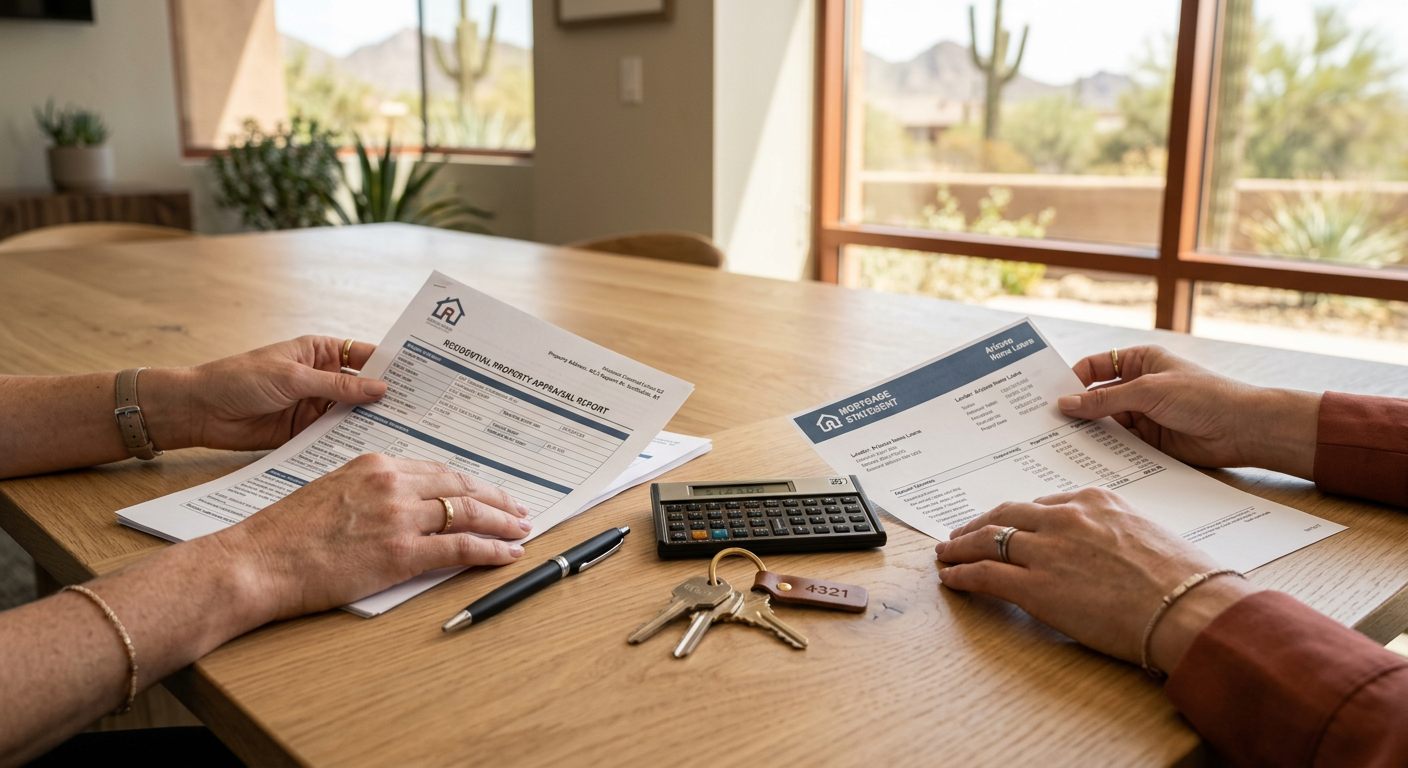
A sound real estate decision begins with reliable facts. Before discussing a buyout, sale, or offset, both spouses should understand the property’s current value, debt, ownership structure, and true cost of keeping or selling it.
We recommend building a property file for each home, rental, land parcel, or commercial holding. It should include:
- A current appraisal, broker price opinion, or other agreed valuation method
- The current mortgage payoff, home equity line balance, and any liens
- The deed, title information, and legal description
- Property-tax bills, insurance costs, homeowners association obligations, and anticipated repairs
- Rental income, leases, operating expenses, and depreciation records for investment property
- Information showing whether separate funds, gifts, inheritances, or premarital equity were involved
Equity is not simply the estimated market value minus the mortgage. A sale may include broker commissions, repairs, concessions, transfer costs, and potential tax considerations. A spouse keeping the property may also need to address future maintenance, insurance, refinancing costs, and the ability to qualify independently for the loan.
What Happens if One Spouse Owned the Home Before Marriage?
A home owned before marriage may begin as one spouse’s separate property, but that does not end the analysis. Community funds, marital earnings, improvements, refinancing, title changes, and the spouses’ efforts during the marriage can all create issues that require careful documentation and analysis.
For example, a physician may have purchased a Phoenix home before marriage, then used marital earnings to pay the mortgage, renovate the kitchen, and fund landscaping improvements over many years. The title alone may not answer every question about the community’s potential interest. Records such as closing documents, mortgage statements, bank records, renovation invoices, and appraisals can be important.
The same caution applies to inherited real estate. Inheritance is generally an exception to community-property classification, but decisions made after inheritance, such as retitling the property or using it in a shared investment strategy, may require a closer review. Couples should obtain individual legal advice about their particular rights before signing an agreement.
Should You Sell the House or Arrange a Buyout?
Selling can provide a clean financial separation, while a buyout can preserve stability and avoid a move. Neither choice is automatically better. The deciding question is whether the proposed arrangement is financially workable and fair when measured against the full marital estate.
Selling the property
A sale may be appropriate when neither spouse wants the property, neither can qualify to retain it, or the home’s equity is needed to establish two households. Couples can agree on the listing agent, listing price range, repair budget, showing rules, occupancy during the sale, and how proceeds will be held and divided.
One spouse keeps the property
When one spouse wants to retain the home, the agreement should address the valuation date, the equity calculation, the buyout method, and a clear refinance or loan-assumption deadline. It should also address what occurs if financing is denied or delayed.
It is especially important to distinguish ownership from loan liability. A divorce agreement can allocate responsibility between spouses, but it does not automatically release a spouse from an existing mortgage. Arizona law specifically cautions that creditors are not bound by a court order or agreement between divorcing spouses. Until a refinance, approved assumption, payoff, or written lender release occurs, both borrowers may remain exposed under the loan.
Using other assets to equalize
Some couples prefer not to sell or refinance immediately. They may instead use other assets to equalize the division, such as brokerage accounts, cash, business interests, or retirement funds. This can be useful, but equal face values do not always produce equal outcomes.
A dollar in a taxable investment account, a dollar of home equity, and a dollar in a pretax retirement plan may have different liquidity, tax, and timing consequences. Our divorce financial planning resources explain why a broader financial analysis can be valuable before couples trade real estate equity for other assets.
How Are Rental and Investment Properties Handled?
Rental and investment real estate should be evaluated as income-producing assets, not just as buildings with estimated market values. A complete review considers debt, net operating income, vacancy risk, deferred maintenance, depreciation, tenant obligations, and likely costs of a future sale.
For a couple with multiple properties, a mediated agreement can be more flexible than a single all-or-nothing decision. One spouse may retain a rental portfolio while the other receives a different mix of assets. Couples may also agree to sell only certain properties, retain a property temporarily, or create detailed management terms for a short co-ownership period.
When the valuation is disputed or the estate includes commercial holdings, a jointly selected appraiser or other neutral professional can help establish a shared factual foundation. Learn more about when appraisals can matter in divorce mediation.
Considering a real-estate-heavy divorce in Arizona? If your decisions involve a family residence, rentals, commercial property, substantial equity, or concerns about privacy, schedule a private consultation with Modern Mediation to discuss a thoughtful process for evaluating your options.
Why Does Timing Matter in Real Estate Division?
Timing can materially affect a real estate settlement. Market conditions, mortgage-rate changes, lease renewals, a child’s school calendar, an upcoming relocation, and the deadline for refinancing can all affect what is practical for a family.
For example, keeping a home jointly for a defined period may help parents maintain stability while a child finishes a school year. That arrangement should not be informal. It needs specific terms for mortgage payments, taxes, insurance, repairs, occupancy, decision-making authority, sale triggers, and how the eventual proceeds will be divided.
Couples should also coordinate real estate choices with retirement planning and other major assets. A spouse who receives more home equity may need different liquid assets than a spouse who receives more retirement assets. Our information on retirement assets and QDRO considerations offers helpful context for evaluating the settlement as one connected financial picture.
How Can Mediation Help With Complex Arizona Real Estate Decisions?
Mediation gives couples a structured private setting to examine several property scenarios rather than argue over a single position. With complete information, couples can compare the financial effect of selling, refinancing, buying out an interest, using an asset offset, or temporarily holding property together.
This approach can be particularly useful for executives, physicians, entrepreneurs, and financially established couples with multiple properties or layered financial obligations. At Modern Mediation, we can coordinate the appropriate financial, valuation, tax, and other professionals when needed, while keeping the conversation focused on informed agreements and workable implementation.
Founder Mara Linder, JD, MA is an Arizona attorney and attorney-mediator with more than 34 years of legal experience, more than 19 years of mediation experience, and more than 2,000 completed mediations. Her counseling background also helps couples have difficult property conversations with greater clarity and less unnecessary conflict.
Frequently Asked Questions
Does it matter whose name is on the deed in an Arizona divorce?
Yes, but the deed is not the only factor. The date and source of acquisition, marital contributions, debt, title history, and applicable agreements can all matter when evaluating a spouse’s interest in real estate.
Can one spouse keep the house without refinancing the mortgage?
Sometimes spouses agree to a temporary arrangement, but the spouse leaving the home may remain liable to the lender if their name stays on the loan. A written agreement should establish a realistic refinance, assumption, sale, or payoff plan and explain what happens if that plan does not occur.
How is home equity calculated in divorce?
Home equity usually begins with a supportable value minus mortgages, home equity lines, liens, and relevant costs. The final calculation may also consider anticipated sale expenses, repairs, separate-property claims, and the larger asset-and-debt division.
Can divorcing spouses continue to own a rental property together?
Yes, but it is generally best treated as a defined business arrangement rather than an open-ended compromise. The agreement should cover management, income, expenses, repairs, tax reporting, refinancing, a future sale, and an exit mechanism.
Do we need an appraisal for every property?
Not always. Couples may agree on a valuation method for a straightforward residence, but an independent appraisal is often useful when the value is disputed, equity is significant, or the property is commercial, unique, or income-producing.
Make Your Real Estate Decisions With the Full Financial Picture
A home or investment property should not be divided in isolation. If you are considering divorce mediation in Scottsdale, Paradise Valley, Phoenix, or elsewhere in Arizona, we can help you evaluate property choices alongside your income, investments, debt, retirement planning, and family priorities.
About Modern Mediation
Modern Mediation is a private, attorney-led divorce mediation firm serving couples throughout Arizona, including Scottsdale, Paradise Valley, Phoenix, and surrounding communities. We help couples address the personal and financial decisions of divorce through a thoughtful alternative to traditional litigation.
Founder Mara Linder, JD, MA is an Arizona attorney with more than 34 years of experience, a divorce mediator with more than 19 years of experience, and has helped more than 2,000 couples through divorce mediation and family transitions.
We frequently work with business owners, physicians, executives, professionals, and couples addressing real estate, investments, retirement assets, executive compensation, and other important financial considerations.
Modern Mediation
7878 N 16th St, Ste 130-15a
Phoenix, AZ 85020
Phone: 480.780.3798
Disclaimer: Modern Mediation works exclusively as a mediator. The information in this article is provided for general educational purposes and is not legal advice. You should consult an attorney regarding your individual legal situation.