

Retirement accounts are often among the largest assets a couple owns, yet they are easy to underestimate during divorce. A settlement may say that one spouse receives a share of a 401(k) or pension, but the retirement plan usually needs its own properly prepared order before it can divide or pay the benefit.
QDRO in Arizona divorce mediation refers to the work of identifying which retirement plans need a Qualified Domestic Relations Order, deciding how the marital portion should be addressed, and coordinating the documents needed to carry out a settlement. This guide explains what a QDRO does, when a different order is required, and how Arizona couples can make retirement decisions with greater clarity.
What is a QDRO in an Arizona divorce?
A Qualified Domestic Relations Order, commonly called a QDRO, is a court order that directs an eligible employer-sponsored retirement plan to recognize and pay a spouse, former spouse, child, or dependent a designated share of benefits. It is not merely a paragraph in a divorce decree. It must satisfy federal requirements and the individual plan’s procedures.
The U.S. Department of Labor notes that employer-sponsored retirement savings are often one of a family’s most significant assets. Its guidance also cautions that, without a valid QDRO, an ERISA-covered plan generally pays benefits only as its written plan document allows. [U.S. Department of Labor QDRO guidance](https://www.dol.gov/agencies/ebsa/about-ebsa/our-activities/resource-center/publications/qdros-practical-guide) explains why the retirement documentation should be addressed early, not treated as an afterthought.
Arizona law calls for an equitable division of community property, though that does not always mean every asset is divided in kind. You can review the statutory language in [Arizona Revised Statutes section 25-318](https://www.azleg.gov/ars/25/00318.htm). In mediation, we help couples consider retirement alongside real estate, liquidity needs, taxes, business interests, and their respective long-range financial plans.
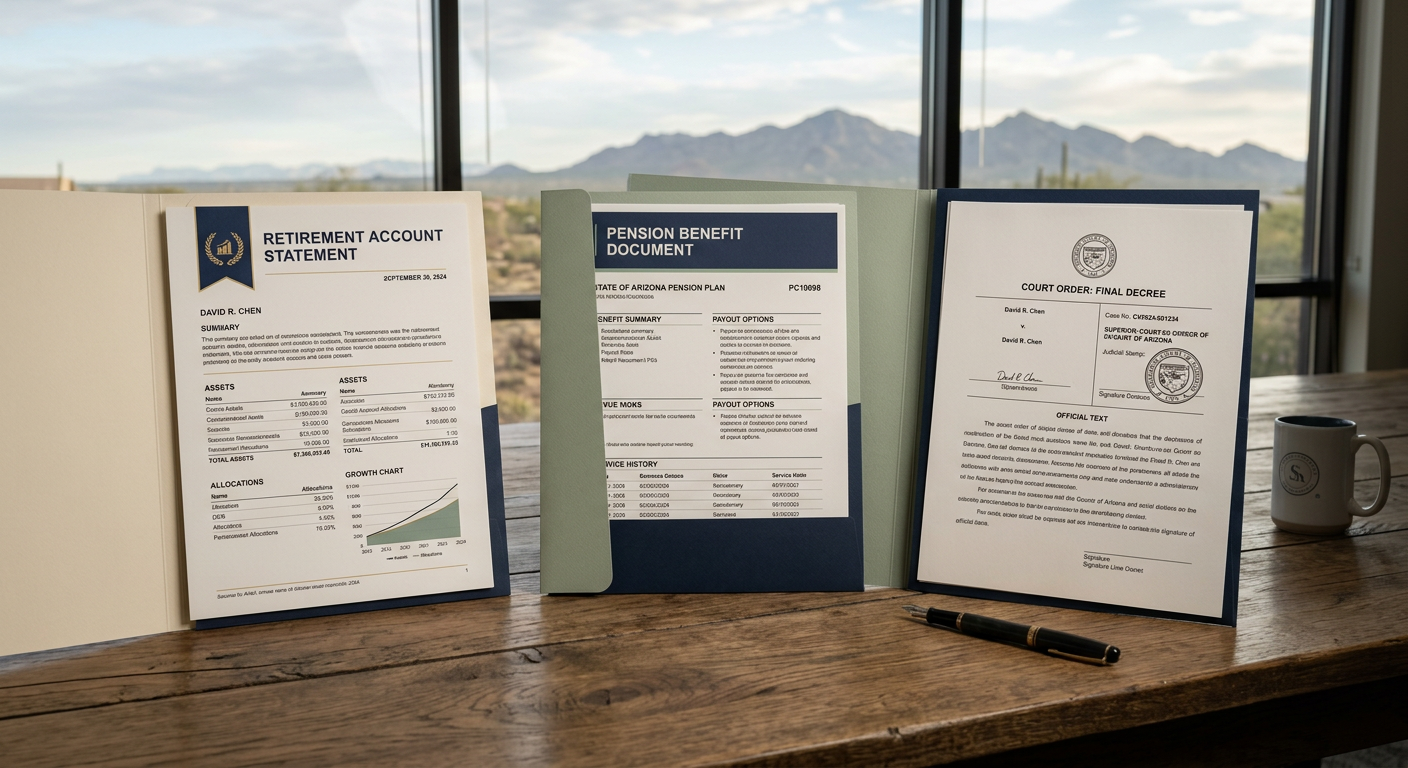
Which retirement accounts need a QDRO?
Many private employer retirement plans use a QDRO, but not every retirement asset does. The account type and plan administrator’s rules determine the appropriate document and process.
Plans commonly divided through a QDRO
- 401(k), profit-sharing, and many employer savings plans
- 403(b) plans that are subject to ERISA
- Defined benefit pension plans
- Some employee stock ownership plans
Plans that may require another process
- IRAs: A QDRO is generally not used. A transfer incident to divorce, completed under the divorce decree or qualifying written instrument, is typically the relevant mechanism.
- Arizona public retirement benefits: Systems such as the Arizona State Retirement System may require a Domestic Relations Order, or DRO, rather than an ERISA QDRO.
- Federal civilian and military benefits: These plans can have separate rules and specialized court orders.
For example, the [Arizona State Retirement System divorce information](https://www.azasrs.gov/content/divorce-information-faqs) explains that a DRO must contain required terms concerning the division, timing, survivor issues, and other plan-specific details. It also states that its draft review process typically takes four to six weeks. That is a practical reason to build retirement implementation into the mediation timeline rather than waiting until the last documents are ready.
How does retirement division work in mediation?
In mediation, retirement division begins with accurate information and a complete settlement picture. Rather than assuming that a simple fifty-fifty split of a statement balance resolves the issue, we help couples identify the type of plan, distinguish possible separate and community components, and consider the practical consequences of different options.
- Inventory the plans. Gather current statements, plan summaries, beneficiary designations, and administrator contact information for every retirement asset.
- Identify key dates. The dates of marriage, service of the divorce petition, employment, and contributions may all matter to the analysis.
- Understand plan terms. Ask whether the plan has model order language, a draft-review process, administrative fees, distribution limits, and special survivor-benefit rules.
- Evaluate settlement alternatives. A couple may divide the account directly, use other assets to offset a retirement interest, or combine approaches when the overall result is well understood.
- Prepare and implement the order. The appropriate QDRO or DRO is drafted, reviewed under the plan’s procedures when available, signed by the court, and submitted for qualification or acceptance.
Our dedicated retirement assets and QDRO guidance addresses why plan-specific terms matter. One divorce may involve several accounts, and each plan can require its own separate documentation.
What decisions should a QDRO address?
A well-considered order does more than assign a percentage. It needs to reflect the agreement and work within the plan’s available benefit options. The details vary substantially between a defined contribution account, such as a 401(k), and a traditional monthly pension.
For a 401(k) or similar account
Key questions may include the division date, the percentage or dollar amount awarded, whether investment gains and losses apply after that date, and how administrative fees are allocated. Couples may also need to decide whether the receiving spouse will keep funds within the plan, if allowed, or complete a direct rollover to an eligible account.
For a pension
Pensions can require additional attention to the formula used, the earliest date an alternate payee may receive benefits, cost-of-living adjustments, subsidies, and survivor benefits. A pension’s future monthly income may have a different practical value than a current account balance, especially for physicians, executives, public employees, and long-tenured professionals nearing retirement.
The IRS confirms that a QDRO cannot award a benefit form or amount that the plan itself does not offer. It also explains that an eligible distribution paid to a spouse or former spouse under a QDRO may be rolled into an IRA or another qualified plan, depending on the circumstances. Review the [IRS QDRO information](https://www.irs.gov/retirement-plans/plan-participant-employee/retirement-topics-qdro-qualified-domestic-relations-order) with a qualified tax professional before making distribution decisions.
Considering a divorce that involves pensions, 401(k)s, deferred compensation, or several retirement plans? We can help you examine the retirement questions within the full financial settlement, including real estate, liquidity, and future income. Schedule a private consultation with Modern Mediation to discuss whether our process fits your circumstances.
Can retirement assets be offset instead of divided?
Sometimes. A direct QDRO division is not the only possible settlement structure. For example, one spouse may retain more of a retirement account while the other receives a greater share of home equity, an investment account, or another asset. Whether that approach is appropriate depends on reliable valuation, tax characteristics, cash-flow needs, risk tolerance, and the complete property settlement.
Equal face values do not necessarily mean equal long-term value. A pre-tax retirement dollar is different from a dollar in cash, and a home may carry future expenses, financing considerations, and potential tax consequences. This is where thoughtful financial expertise during divorce can help couples test options before committing to a division method.
What are common QDRO mistakes to avoid?
The most costly errors are often procedural. They can cause delays, require revised court documents, or leave important survivor and payment questions unresolved.
- Assuming the divorce decree alone directs the plan to transfer funds
- Using generic language without reviewing the plan’s required terms
- Waiting until long after the divorce to begin the order process
- Overlooking pre-marital contributions, rollovers, or the agreed valuation date
- Failing to address investment gains and losses after the division date
- Ignoring pension survivor benefits or retirement timing provisions
- Taking a cash distribution without understanding potential tax consequences
- Forgetting to update beneficiary designations and broader estate planning documents after divorce
There is also an important communication point. Retirement decisions can feel deeply personal because they represent years of work and future security. A neutral, structured process can make it easier to discuss concerns openly and focus on informed options rather than positional conflict. When a financial estate is particularly layered, our Premier Team Mediation™ process can coordinate the right retirement, financial, and other professional support.

Why timing matters for QDROs in Arizona divorce mediation
Starting early helps prevent a retirement order from becoming a loose end after the divorce is finalized. We encourage couples to obtain plan documents and ask about draft review before finalizing the settlement language whenever possible. That approach can reveal plan limitations while there is still time to adjust the agreement.
Timing also matters because account values move, retirement elections may change, and an unexpected death or retirement can complicate an incomplete order. For couples with executive compensation, several plans, pensions, or public-sector benefits, the retirement analysis should be part of the larger settlement design, not a final administrative task.
Frequently Asked Questions
Do all Arizona divorces need a QDRO?
No. A QDRO is generally used for eligible employer-sponsored plans, not every retirement asset. IRAs usually use a transfer incident to divorce, while Arizona public retirement systems and federal plans may require different court orders and procedures.
Who prepares a QDRO in an Arizona mediated divorce?
Preparation may be handled by a professional experienced in retirement division and the applicable plan’s requirements. In mediation, the couple’s settlement terms should be clear enough for the drafter to prepare the appropriate order, and the plan administrator’s procedures should be followed carefully.
Can a QDRO be completed after the divorce decree is entered?
It can sometimes be completed afterward, but postponing it can create unnecessary risk and delay. Beginning the process before finalizing the divorce allows the plan’s requirements to inform the settlement and helps both spouses know how implementation will occur.
Will a QDRO cause taxes or penalties?
It depends on how benefits are paid and what the recipient does with them. A direct rollover may preserve tax-deferred treatment when available, while a cash distribution can have tax consequences. Individual tax advice should come from a qualified tax professional who understands the proposed transaction.
Can we divide a pension without selling other assets?
Often, yes. A pension may be divided through a QDRO or another appropriate order, but the available options depend on the plan and the settlement terms. Some couples instead negotiate an offset with other assets after considering value, taxes, liquidity, and retirement goals.
Bring Retirement Decisions Into the Full Settlement Conversation
A QDRO is a technical document, but the choices behind it are human and financial. The right path depends on your plans, the length of the marriage, your other assets, your desired retirement timeline, and what financial security means for each of you after divorce.
For Arizona couples who want a private and organized way to resolve complex financial questions, we provide attorney-led mediation that keeps the focus on informed decision-making. Learn more about the Modern Mediation team, or schedule a private consultation to discuss your retirement and divorce mediation concerns.
About Modern Mediation
Modern Mediation is a private, attorney-led divorce mediation firm serving couples throughout Arizona, including Scottsdale, Paradise Valley, Phoenix, and surrounding communities. We help couples navigate the personal and financial decisions that come with divorce through a thoughtful alternative to traditional litigation.
Founder Mara Linder, JD, MA is an Arizona attorney with more than 34 years of experience, a divorce mediator with more than 19 years of experience, and has helped more than 2,000 couples through divorce mediation and family transitions.
We frequently work with business owners, physicians, executives, professionals, and couples navigating real estate, investments, retirement assets, executive compensation, and other significant financial considerations.
Modern Mediation
7878 N 16th St, Ste 130-15a
Phoenix, AZ 85020
Phone: 480.780.3798
Schedule a Private Consultation with Modern Mediation
Disclaimer: Modern Mediation works exclusively as a mediator. The information in this article is provided for general educational purposes and is not legal advice. You should consult an attorney regarding your individual legal situation.
Disclaimer: Modern Mediation works exclusively as a mediator. The information in this article is provided for general educational purposes and is not legal advice. You should consult an attorney regarding your individual legal situation.