

When parents separate, the calendar can become one of the most emotionally charged parts of the divorce. School mornings, holidays, medical appointments, sports, travel, and new partners can all create friction if expectations are unclear. A thoughtful parenting plans in Arizona divorce mediation process helps parents move beyond broad promises to create a workable plan for their children and their real lives.
We help Arizona parents identify the decisions that matter most, have the difficult conversations in a structured setting, and build clear agreements with room for their children to grow. This article explains what an Arizona parenting plan covers, how mediation can support better co-parenting decisions, and where financially established families may need added planning around demanding careers, travel, privacy, and family resources.
What Is an Arizona Parenting Plan?
An Arizona parenting plan is a written agreement or court-ordered framework addressing legal decision-making, parenting time, exchanges, communication, and ways to handle future disagreements. It should be practical enough to guide an ordinary Tuesday, not merely a document that addresses major holidays.
Arizona law requires parenting plans to address key matters, including the type of legal decision-making, each parent’s responsibilities, a practical parenting-time schedule, exchanges, communication, plan review, and dispute resolution. The statute specifically calls for “a practical schedule of parenting time” that includes holidays and school vacations. Arizona Revised Statutes § 25-403.02
In Arizona, legal decision-making and parenting time are related but different concepts:
- Legal decision-making concerns authority for major decisions involving education, health care, religious training, and personal care.
- Parenting time concerns when the children are with each parent.
- Joint legal decision-making does not automatically mean equal parenting time.
The best plan is rarely the most elaborate one. It is the one both parents understand, can realistically follow, and can use without revisiting every minor detail as a conflict.
How Does Divorce Mediation Help Parents Create a Parenting Plan?
Divorce mediation gives parents a confidential, guided setting to discuss their children’s routines, priorities, and practical constraints before putting terms into a written plan. Rather than asking a judge to decide every contested detail, parents can develop options that fit their family’s schedule and values.
In mediation, we usually begin with the child’s current rhythm. That includes school, friendships, learning needs, activities, health needs, bedtime patterns, travel, and each parent’s work responsibilities. From there, we help parents separate what is truly important from what may be a reaction to the stress of divorce.
Why a child-centered approach matters
Arizona courts determine legal decision-making and parenting time based on the child’s best interests. Relevant considerations include each parent’s relationship with the child, the child’s adjustment to home, school, and community, the child’s wishes when appropriate, health and safety concerns, and each parent’s willingness to support meaningful contact with the other parent. Arizona Revised Statutes § 25-403
Mediation does not remove the importance of these considerations. It creates an opportunity to address them thoughtfully, before disagreement hardens into positions. For many parents, that helps preserve a more functional relationship after the marriage ends.
What Should Parents Include in a Detailed Parenting Plan?
A durable parenting plan answers recurring questions before they become emergencies. It should give children predictability while recognizing that work, school, and family life will evolve over time.
Regular parenting-time schedule
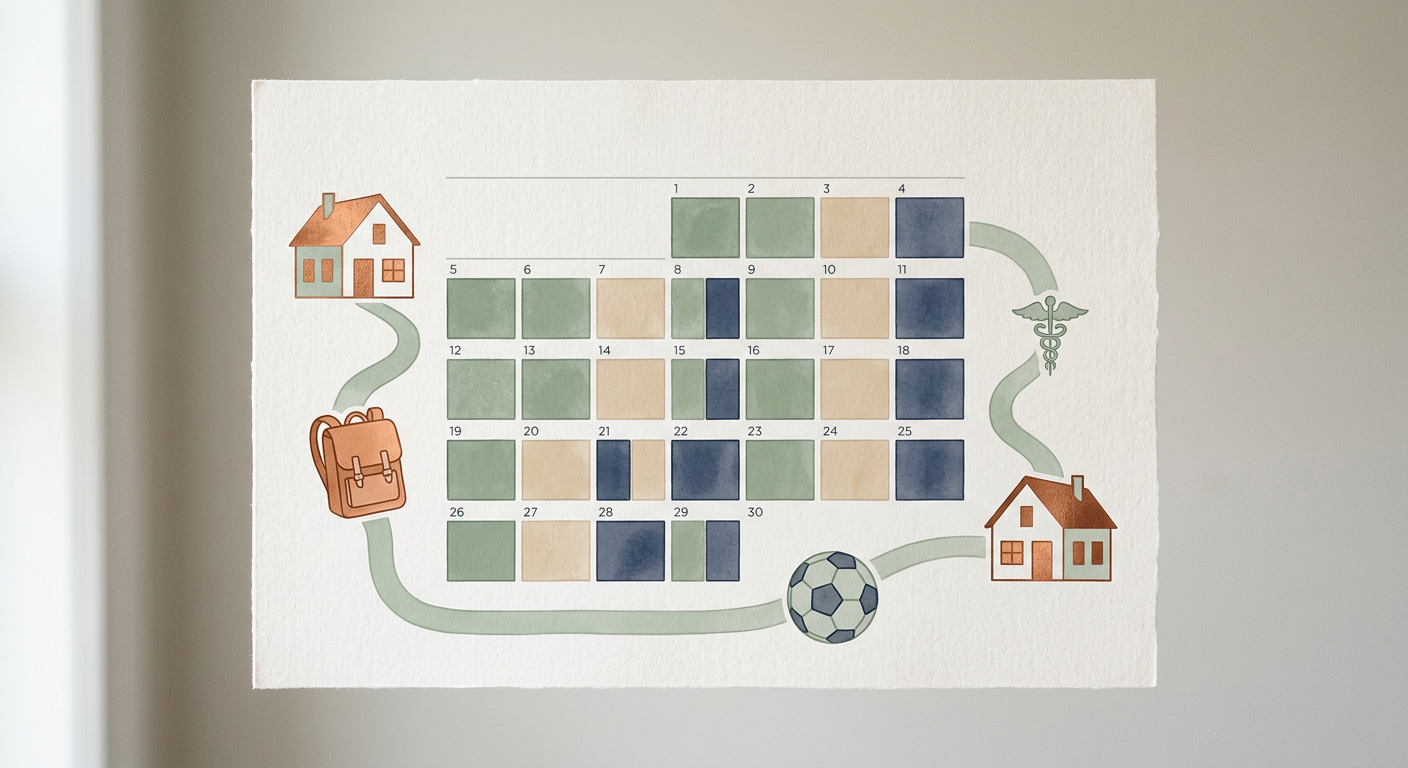
Start with the normal week. Identify overnights, school-day transitions, after-school care, activity transportation, and how the schedule works when a child is sick. A physician’s call schedule, an executive’s travel, or an entrepreneur’s seasonal business demands may call for a more tailored approach than a standard alternating-week schedule.
Holidays, school breaks, and birthdays
Holiday provisions should name the holiday, beginning and ending times, whether the schedule alternates by year, and how school breaks are handled. Consider birthdays, Mother’s Day, Father’s Day, religious observances, extended-family celebrations, and summer vacation planning.
Decision-making for education and health care
Parents should be clear about how they will make major decisions, share records, communicate with teachers and medical providers, and handle nonemergency care. It can also help to define who may make routine day-to-day choices during that parent’s parenting time.
Exchanges and transportation
Exchange terms should cover locations, transportation responsibilities, punctuality, and how parents will communicate about delays. For families with high conflict or safety concerns, the exchange protocol deserves particular care. Mediation may not be appropriate in every situation, especially where domestic violence, coercion, intimidation, or safety concerns affect a parent’s ability to negotiate freely.
Communication and resolving future disagreements
Decide which communication method will be used, how quickly parents should respond to child-related requests, and what information should be shared. A plan can also establish a sequence for future disputes, such as direct discussion, mediation, or another agreed process.
Considering a parenting plan with complicated schedules or sensitive family dynamics? We can help you explore whether a private, attorney-led process is a good fit. Schedule a private consultation with Modern Mediation.
How Can Arizona Parents Handle Demanding Careers and Complex Family Logistics?
Parenting plans for professionals and business owners need to be grounded in reality. A plan that ignores operating-room shifts, client travel, quarterly deadlines, business ownership duties, or regular out-of-state commitments may create avoidable stress for both parents and children.
We encourage parents to discuss foreseeable demands without treating a changing schedule as a reason to abandon structure. The goal is a dependable default schedule combined with a fair process for limited adjustments.
- Set notice expectations for known work travel and school events.
- Clarify how make-up parenting time will be requested and scheduled.
- Address children’s travel, passports, itineraries, and contact while away.
- Consider how nannies, grandparents, and other trusted caregivers fit into the routine.
- Coordinate the parenting plan with decisions about the family home, school enrollment, and financial support.
When parenting concerns overlap with sophisticated financial decisions, our Premier Team Mediation™ process can bring appropriate parenting, financial, and other professionals into the conversation. This can be particularly helpful when a family is also working through business interests, retirement assets, real estate, or long-term cash-flow planning.

What Parenting Plan Mistakes Create Problems Later?
Many disputes begin with a plan that sounded cooperative when it was signed but provides too little guidance once life becomes busy. Parents do not need to predict every future scenario, but they do need to address the patterns most likely to repeat.
Using vague language
Phrases such as “reasonable parenting time” or “parents will work it out” may be workable for some families, but they can create uncertainty when communication is strained. Clear starting and ending times, notice periods, and exchange procedures reduce the need for repeated negotiation.
Confusing equal time with shared authority
Parents sometimes assume that joint legal decision-making requires an equal parenting-time schedule. Arizona law makes clear that shared legal decision-making does not necessarily mean equal parenting time. The right structure depends on the child’s best interests and each family’s circumstances.
Leaving finances out of the parenting conversation
Children’s expenses do not stop at basic support. Parents may need to discuss private school tuition, tutoring, camps, travel teams, therapy, uninsured medical care, vehicles, college savings, and extracurricular activities. A sound agreement distinguishes ordinary expenses from larger or discretionary costs that require advance discussion.
Failing to plan for change
Children’s needs change quickly. A plan should provide a reasonable method for review, whether that is an annual calendar meeting, a discussion before each school year, or a mediated process if parents reach an impasse.
When Is Divorce Coaching Helpful for Co-Parenting Decisions?
Co-parenting requires emotional discipline as well as logistics. When grief, anger, fear, or communication patterns are making it difficult to focus on the children, divorce coaching can help a parent clarify priorities and prepare for more productive mediation conversations.
Our divorce coaching support is designed to help clients manage the human side of divorce, including communication, values-based decisions, and the transition to a co-parenting relationship. Coaching is not therapy or legal representation, but it can be an important source of support during a demanding family transition.
Frequently Asked Questions
Do Arizona parents have to create a parenting plan in divorce?
When a divorce involves minor children, legal decision-making and parenting time must be addressed. If parents cannot agree, Arizona law requires each parent to submit a proposed parenting plan, and the court determines unresolved terms.
Can parents make their own parenting schedule in Arizona mediation?
Yes. Parents can work together in mediation to develop a schedule that fits their children and family circumstances, subject to the legal requirements and best-interests considerations that apply in Arizona.
Does joint legal decision-making mean a fifty-fifty parenting schedule?
No. Joint legal decision-making concerns authority for major decisions. It does not automatically require an equal division of parenting time.
What happens if a child’s needs or a parent’s work schedule changes?
A well-written plan includes a process for adjustments, review, and dispute resolution. Parents may be able to resolve routine changes by agreement, while more significant changes may require additional mediation, legal guidance, or court action.
Can mediation work when parents disagree about school, health care, or travel?
Often, yes. Mediation can help parents identify the interests beneath the disagreement, gather needed information, and evaluate workable options. It may not be suitable when safety concerns, coercion, or an inability to negotiate freely are present.
A Thoughtful Parenting Plan Can Protect the Next Chapter
A parenting plan is more than a custody calendar. It is a working framework for how your family will handle ordinary routines, important decisions, and inevitable change after divorce. The more clearly it reflects your children’s needs and your actual lives, the more likely it is to support stability without unnecessary conflict.
For Scottsdale, Paradise Valley, Phoenix, and Arizona families with busy professional lives or important financial considerations, a private mediation process can create space for patient problem-solving. We help parents focus on the future relationship their children will need from them, not simply the disagreement in front of them.
Build a Parenting Plan With Greater Clarity and Care
If you are considering divorce and want a parenting plan that accounts for your children, schedules, finances, and privacy, we invite you to talk with us. Modern Mediation provides a thoughtful, attorney-led process for Arizona couples seeking a constructive alternative to traditional litigation.
About Modern Mediation
Modern Mediation is a private, attorney-led divorce mediation firm serving couples throughout Arizona, including Scottsdale, Paradise Valley, Phoenix, and surrounding communities. We help couples navigate the personal and financial decisions that come with divorce through a thoughtful alternative to traditional litigation.
Founder Mara Linder, JD, MA is an Arizona attorney with more than 34 years of experience, a divorce mediator with more than 19 years of experience, and has helped more than 2,000 couples through divorce mediation and family transitions.
We frequently work with business owners, physicians, executives, professionals, and couples navigating real estate, investments, retirement assets, executive compensation, and other significant financial considerations. Learn more through our Arizona divorce mediation questions and answers.
Modern Mediation
7878 N 16th St, Ste 130-15a
Phoenix, AZ 85020
Phone: 480.780.3798
Disclaimer: Modern Mediation works exclusively as a mediator. The information in this article is provided for general educational purposes and is not legal advice. You should consult an attorney regarding your individual legal situation.